Safety & QHSE
Safety & QHSE at PMI Energy Services
The safest tank entry is the one nobody makes. Everything here, the automation, the training program, the monitoring and the authority every employee holds to stop a job, exists to reduce the number of times a person has to be in the hazard at all.
The record
Stop Work Authority held by every employee
Stop Work Authority
Anyone on the job can stop the job.
Every PMI Energy Services employee, first day on the crew included, holds the authority to stop work when something looks wrong. No permission needed, no consequence for using it, and no job restarts until the concern is resolved and documented.
It is the cheapest safety control there is, and the one that requires the most management discipline to mean anything. Ours is enforced by supervisors, not just printed in a handbook.
What that looks like in practice
- Pre-job JSA reviewed with the whole crew, not signed in a truck
- Atmospheric monitoring logged continuously, not spot-checked
- Confined space rescue capability staffed in-house on every entry
- Stop-work events investigated and closed out in writing
- Near misses reported without blame and shared across crews
The program
Geaux PMI 6S: the system behind every job site
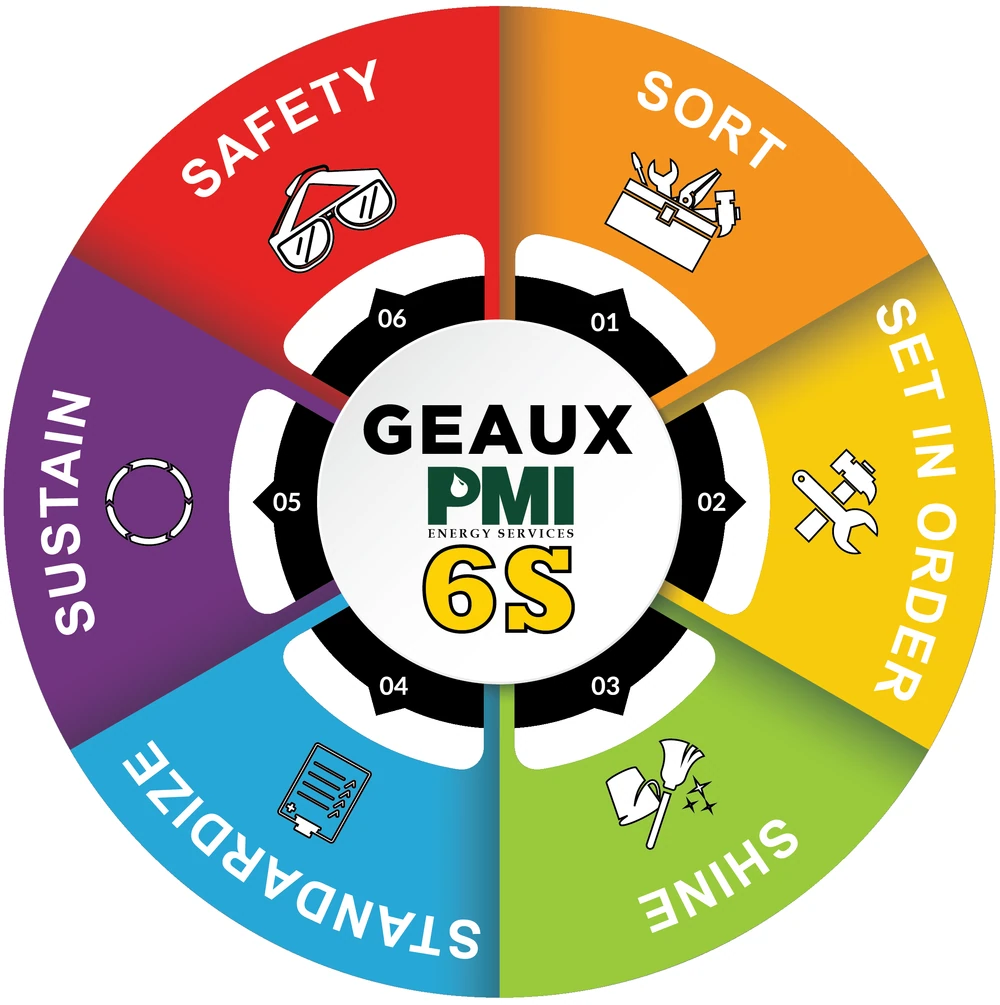
Geaux PMI 6S is how PMI keeps its shops, trucks and work areas in order. It starts from 5S, the workplace system built on Sort, Set in Order, Shine, Standardize and Sustain, and adds a sixth step that PMI treats as the most important one: Safety. None of it is a poster on a wall. Tools have a marked place, equipment is cleaned and checked every day, and hazards get found and removed before a job starts. For a customer that means a crew that shows up organized and equipment that works when it arrives.
Sort
Every crew clears out anything not used on the job. If it is not needed daily, it gets stored or removed. A cluttered site is where injuries start.
Set in Order
Tools and materials get a fixed, marked place, positioned so the crew can reach them without bending, twisting or hunting. Frequently used items sit closest to hand.
Shine
Equipment and the work area get cleaned every day, not just when something breaks. The daily Shine round doubles as an inspection, catching wear before it becomes a failure.
Standardize
Checklists and schedules turn Sort, Set in Order and Shine into a routine every crew follows the same way, every time, not a one-time cleanup.
Sustain
The discipline holds past the first week. Supervisors keep the habit going with regular follow-through, not just a kickoff.
Safety
PMI's sixth pillar covers the hazards on a job site: eye wash and shower stations, first aid kits staged on trucks and in shops, PPE, and staff trained in first aid, CPR and AED use.
How it shows up on your job
- A Red Tag process flags anything that does not belong on site, with a clear next step: leave it, relocate it, dispose of it, recycle it, or hold it in a marked area for review.
- Storage is labeled top to bottom: tool boxes, walls, floors and walkways, so any crew member can find what they need without asking.
- The daily Shine round is also a maintenance check, catching a worn part or a loose fitting before it causes a breakdown.
- Standardize runs on a written routine and periodic evaluation, so the same steps happen the same way on every crew, every day.

Accredited and taught in-house
PMI runs its own accredited training program rather than outsourcing certification to whoever is cheapest that quarter. Crews are trained on the equipment they will actually operate, by people who have run it, and re-certified on a schedule the client can audit.
Confined space & rescue
Entry, attendant, supervisor and rescue roles: rescue is staffed in-house.
H2S & atmospheric hazards
Detection, respiratory protection and evacuation procedure for sour service.
Automated systems operation
RoosterEX and MudHog setup, operation and troubleshooting on live tanks.
Environmental & NORM handling
Surveying, containment, packaging and documentation requirements.
Common questions
What does the 6 in 6S stand for? Isn't the standard system 5S?
The workplace-organization system most companies use is 5S: Sort, Set in Order, Shine, Standardize, Sustain. PMI adds Safety as a sixth pillar, calling it the most important element in the process.
What happens to tools or materials that do not belong on a job site?
They go through the Red Tag process: leave it, relocate it, dispose of it, recycle it, or place it in a marked holding area for review.
Is Standardize just a one-time cleanup?
No. Standardize turns Sort, Set in Order and Shine into a daily routine backed by checklists and periodic evaluation, so crews keep following it long after the initial setup, not just the week it launches.
Monitoring
AI camera monitoring on the work face
Cameras watch the areas where the risk actually lives, the entry point, the hose runs, the equipment spread, and flag unsafe conditions in real time instead of at the end of a shift. A missing harness, a person where a person shouldn't be, a hazard developing behind someone's back.
It exists to catch what human attention loses after ten hours in the heat, and the record it produces is available to clients who want it as part of the turnover package.
Real time
Alerts as conditions develop, not in a report later.
On the work face
Coverage at the entry, spread and hose runs.
Auditable
Records available with the job documentation.
Documentation
What your auditors receive
Records are assembled while the job runs, not reconstructed afterward. Every scope closes with a package your HSE and compliance teams can work from directly.
JSAs & permits
Job safety analyses, entry permits and lockout records for every phase of the work.
Monitoring & sampling
Atmospheric logs, waste characterization results and gas-free certification.
Disposal & photo record
Manifests for anything hauled, plus photo documentation of the tank at turnover.