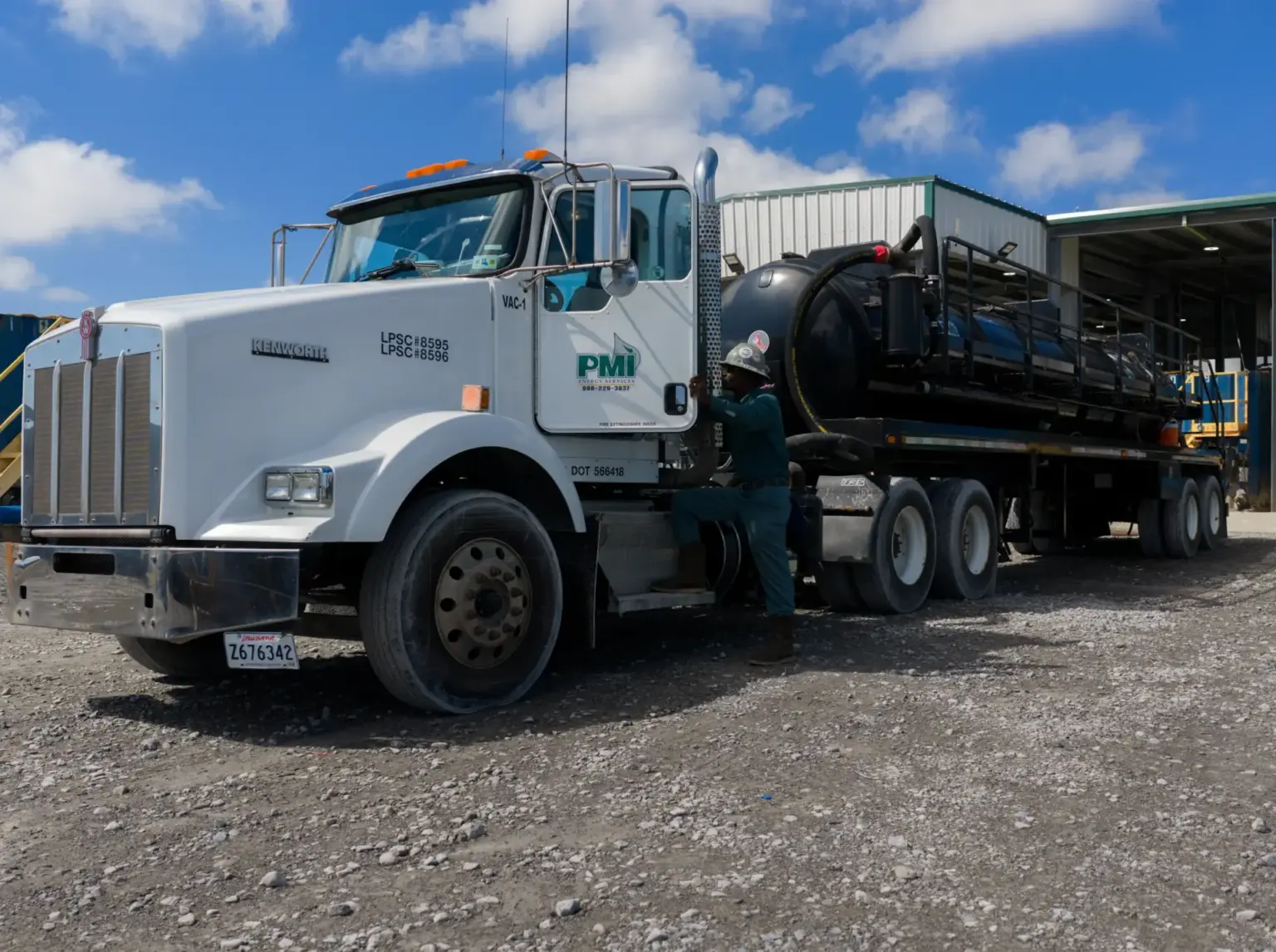
Tank Battery Decommissioning
One crew takes the battery down and hands back clean ground.
PMI decommissions tank batteries end to end, from draining the last crude and produced water to sampling the soil underneath and restoring the site.

The record
- 3,000+Projects completed
- 7States worked
- 50+Years in operation

The problems this ends
Idle iron that costs money to monitor and produces almost nothing.
A property sale that cannot close until the battery is gone and the soil report is clean.
Four contractors on one pad, each waiting on the last to finish.
Vessels nobody will cut because the sludge and the vapor are still in them.
Scale turning up mid-teardown, with no licensed surveyor on site and equipment on the clock.
A closure file assembled years later out of four vendors’ paperwork.
Scope of work
What you get
That means draining and disposing of the residual crude, produced water and bottoms, degassing and washing the vessels, cutting down steel and fiberglass tanks, treaters, separators, piping and concrete, and hauling the iron out for scrap or salvage before the soil work starts.Tank cleaning, NORM surveying and soil remediation are all PMI services with PMI crews, so a scale reading or a chloride pocket found mid-teardown does not stall the job waiting on somebody else to mobilize.
Fluid removal and disposal
Residual crude, produced water and bottoms pulled from tanks, treaters and flow lines, then disposed of through licensed facilities.
Cleaning and degassing
Vessels washed, vented and vapor-freed so hot work and teardown are safe to start.
NORM survey before anything is cut
Pipe and vessels screened by our own licensed people, so contaminated steel is segregated instead of scrapped.
Dismantling and demolition
Steel and fiberglass tanks, treaters, separators, piping manifolds and concrete retaining walls cut down and cut up.
Haul-off, scrap and salvage
Iron transported off site, scrap routed to recycling, reusable equipment salvaged back to you, the rest to licensed disposal.
Soil sampling and remediation
Samples pulled beneath and around the footprint, especially at old spill points, sumps and liners, then impacted soil excavated or treated where the results call for it.
Backfill, grading and restoration
Excavations backfilled with clean tested soil, re-contoured to the surrounding grade and seeded against erosion.
Permits, manifests and close-out file
Demolition permits filed, waste manifests and NORM chain of custody generated, lab results and post-reclamation reports in one file.
The procedure
How the job runs
The sequence below is the one our supervisors and crews work to on this scope. Readings, permits and sign-offs are documented as the job moves through it.
Assess and scope
Site walkthrough covering layout, fluid volumes, spill history and access, then a written scope and quote.
Permit and isolate
Permits filed, JSAs written, tie-ins locked and tagged out, NORM survey run before any steel is cut.
Drain, wash and tear down
Fluids vacuumed out, vessels degassed, iron dismantled and hauled, scrap and salvage separated.
Sample and restore
Soil sampling and any excavation, then backfill, grading and sign-off.
From the field
A tank battery taken down to clean ground
What we did
PMI cleaned, sheared and removed a tank battery as one piece of a much larger closure program on the same asset. The flow lines feeding it were NORM impacted, so the survey work sat with our crews as well, and the battery came down alongside the rest of the field rather than as a separate mobilization.
The situation
The operator was carrying a field's worth of legacy production infrastructure: well sites, pits, flow line and batteries, all of it needing to come out under one program instead of one pad at a time, and the work ran year-round through weather and seasons.
The result
By the end, PMI had removed 48 miles of flow line, closed 128 pits, and taken the tank battery down to clean ground. The program ran more than five years and remains one of the largest jobs PMI has performed.
Questions we get
Tank Battery Decommissioning FAQs
What is included in a full tank battery decommissioning?
Fluid removal, cleaning and degassing, a NORM survey, then the teardown and haul-off of tanks, treaters, separators, piping and concrete. Soil sampling follows, with remediation where the results call for it, then backfill, grading and the close-out file.
Can we get any value back out of the equipment?
Often, yes. Working separators, line heaters and structural steel can go back to your inventory or be credited as scrap against the cost. What is recoverable gets sorted during the teardown, not assumed at the quote.
What happens if you find NORM once the teardown starts?
Work stops in that area, the impacted material is mapped and segregated, and it leaves manifested to a licensed facility rather than on a scrap ticket. PMI holds its own NORM license and its own Radiation Safety Officer, so nothing waits on a third party.
What happens if the soil under the tanks is contaminated?
Our own remediation crews delineate the impacted area, excavate or treat it, and confirm the result by lab sampling before backfill. In-house dirt work is what keeps that discovery from becoming a second project.
Do we need separate contractors for cleaning, NORM and dirt work?
No. Tank cleaning, NORM surveying and soil remediation are all PMI services run by PMI people, which is most of the reason a battery is worth doing as one scope.
What paperwork do we get at the end?
A close-out package: wash tickets, scrap and recycling receipts, waste manifests, NORM chain of custody and independent lab soil results, packaged to answer questions years later.
What do we still have to handle on our side?
Mineral rights, your environmental liability tracking, the operator sign-off and lease termination filing, and the surface landowner relationship. Permits, manifests, NORM documentation and soil reporting are ours.
Send us the battery.
Tell us how many vessels, what is still in them, and when the site has to be clear. Our team walks the site, writes the scope, and dispatch answers around the clock.