Pipeline Flushing
The line comes clean, and the flush water goes back in it.
PMI flushes pipelines in multiple diameters, onshore and offshore, and treats the flush water on site in our EC-AOP units, so 95 to 97 percent of it goes back into the launcher instead of onto a vacuum truck.

The record
- 95 to 97%Flush water reclaimed on site
- 3 to 5%Leaves as inert solids
- 25 GPMPer EC-AOP unit, scalable
- 2 to 4 hrsTo set a unit and start treating

The problems this ends
A smart pig run scrubbed at the last minute because the line still holds wax and scale.
Product switched into a line nobody swept, and the first batch comes out off-spec.
Mill scale and debris left in new pipe, pitting it before the hydrotest passes.
An idle line still holding mobile hydrocarbons that cannot be cut, capped or abandoned.
Vacuum trucks hauling flush water off site load after load, at disposal rates, for weeks.
Four vendors on one flush: pumps, chemistry, separation, water disposal, each waiting on the last.
Scope of work
What you get
We flush everything from gathering lines to transmission trunks: crude, produced water, refined products, natural gas, and NGL and chemical transfer lines. Offshore and subsea lines are part of the work. Our crews set the temporary pump skids and launchers, run the pigs, sweep the line with surfactant or acid, and separate everything that comes back out.The water is the part most contractors hand to somebody else, and the part we keep.
Flush plan and flow loop
Engineered off the line’s diameter, length, elevation profile and what is fouling it, then rigged as a closed loop wherever the site allows.
Pump skids and temporary launchers
High-volume, high-pressure skids, manifold tie-ins and temporary launchers and receivers, mobilized and set by PMI crews.
Mechanical pig run
Squeegee, brush or foam pigs driven with water or nitrogen, displacing the bulk fluid and taking paraffin, scale and residue off the wall.
Chemical sweep
Custom-blended surfactants for heavy wax and crude film, or organic acids for scale and iron sulfide, matched to the foulant rather than ordered off a shelf.
Capture, separation and vapor control
Everything leaving the pipeline goes to high-rate separation, where solids drop out and the fluids stratify into oil and water, with the vapors routed through carbon or chemical scrubbers.
On-site water reclamation
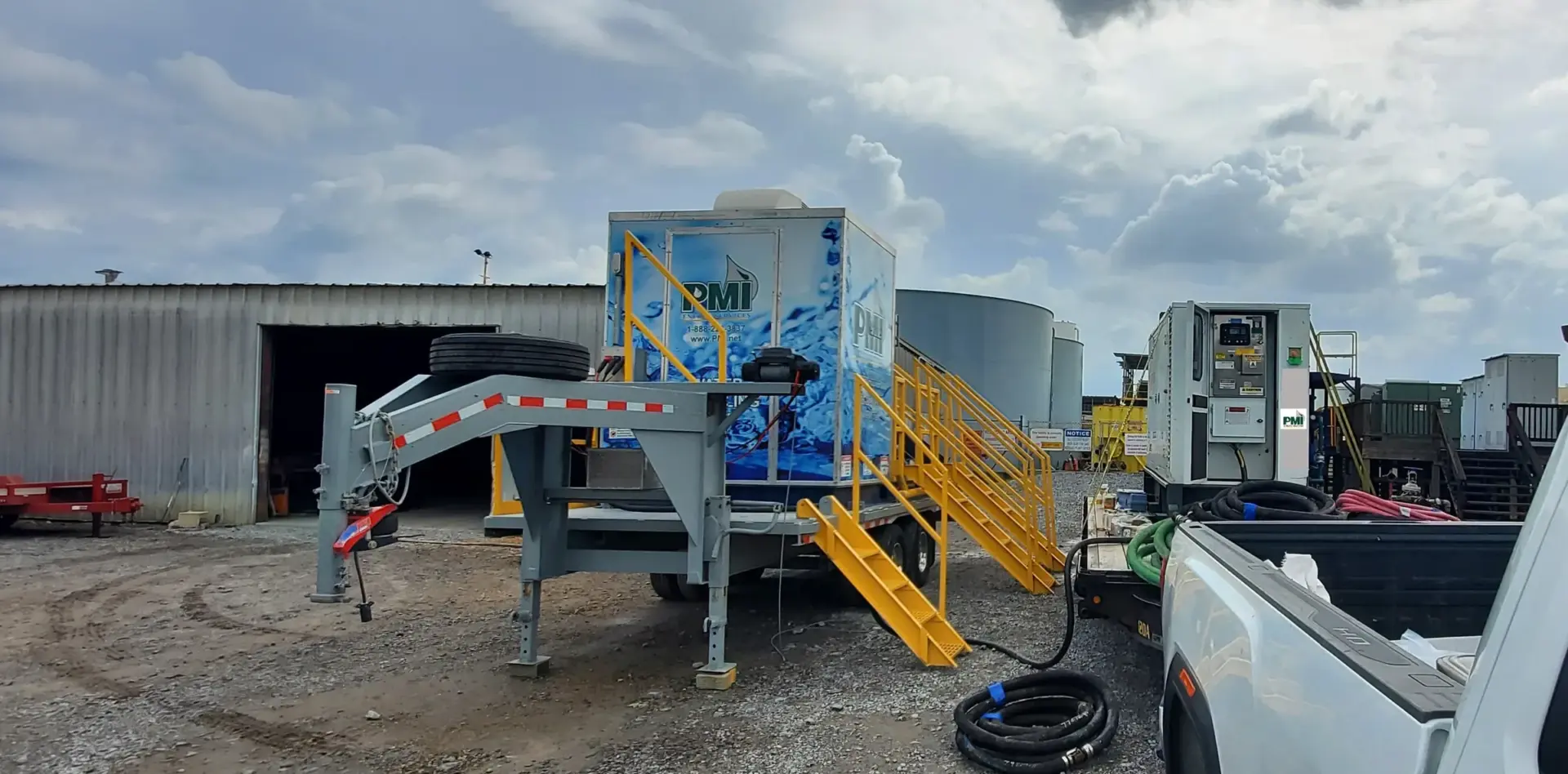
Flush water is treated in a PMI EC-AOP unit and pumped back to the launcher, so the same water works the job more than once.
Job records
Pressure logs, chemical titration records, volume charts and waste manifests, packaged as the file for the flush.
Equipment on this service
The technology doing the work
From the field
Aviation fuel out of an island fuel system
What we did
PMI was brought in to remove the aviation fuel left standing in a military-operated island fuel system, pull the fuel lines that had to come out, and plug and cap the rest.
The situation
The fuel had been left standing in the island's fuel lines. The site's Native American owners were part of the job from the start, and PMI personnel worked alongside them for its length.
The result
Six months in, the fuel was out, the lines that needed to go were gone, and the ones that stayed were plugged and capped.
Questions we get
Pipeline Flushing FAQs
When does a pipeline need a flush?
Usually right before something else can happen. The four common triggers are an in-line inspection run, a change of service, hydrotest support after construction or repair, and abandonment prep.
What do you flush with?
It depends on what is in the line. A pig run driven by water or nitrogen goes first and displaces the bulk fluid, then a chemical sweep does the rest: surfactants for wax and crude film, organic acids for scale and iron sulfide.
What types of line do you flush?
Crude, produced water, refined products such as diesel, jet fuel and gasoline, natural gas, and NGL or chemical transfer piping. We work across multiple diameters, onshore and offshore, including subsea lines.
What happens to everything that comes out of the line?
It goes into a controlled separation system, not a tank for someone else to sort out. Paraffin and scale settle in the chambers, the fluids stratify into oil and water, and the vapors route through carbon or chemical scrubbers.
Can the flush water be reused instead of hauled off?
Yes, and that is the argument for running the flush with us. Our EC-AOP units treat the returning water on site, and 95 to 97 percent of it is clean enough to go back into the launcher. Three to five percent leaves as inert solids.
Is flushing the same as pipeline abandonment?
No. Flushing is maintenance on a working asset: pigging support, product changes, hydrotests. Abandonment is closure, with cutting, capping, grouting and a regulatory file. A flush is usually the first step of an abandonment, and PMI does both.
Who actually does the work?
PMI crews, with PMI equipment. The pumps, the pigging, the chemistry, the separation and the water treatment are all ours, so the schedule never sits waiting on a fourth vendor. We have been at this work for more than 50 years.
Tell us what is in the line.
Send the diameter, the length, the product it has carried and the date it has to be clean. Our team will scope the flush with you, and dispatch answers around the clock.