Dehy System Flushing (Glycol & Amine)
Flush the glycol or amine unit on your schedule, not after it fails.
PMI chemically flushes glycol dehydration units, amine sweetening systems and the heat exchangers that serve them, and brings the unit back on fresh glycol or amine before fouling pushes the gas off spec.


The problems this ends
Gas going off spec on water dew point or H₂S and CO₂, with penalties or a shut-in close behind.
A contactor foaming and carrying glycol or amine down the pipeline.
A reboiler burning more fuel gas every month to hold its temperature.
Differential pressure climbing across the filters, the carbon bed or the tower.
An exchanger fouled with scale, hydrocarbons or polymer that nobody has time to open up.
Spent chemistry and sludge at the end of the job, and no plan for where it goes.
Scope of work
What you get
Over time glycol breaks down in the heat of the reboiler and turns into an acidic sludge, amine reacts with CO₂ and H₂S to form heat stable salts that corrode and foul the system, and hydrocarbons and solids get into the loop. Left alone, that fouling pushes the gas off spec and costs fuel until the unit has to come down.We isolate the system, circulate a cleaning chemistry matched to what is fouling it, handle the waste and bring the unit back on fresh glycol or amine. Heat exchangers can be flushed in place or brought to our own shop.
Glycol dehydration units
Chemical flushing of TEG and EG dehydration systems fouled with degraded glycol sludge, hydrocarbons and suspended solids.
Amine sweetening systems
Chemical flushing of MEA and MDEA amine units fouled with heat stable salts, corrosion products and hydrocarbons.
Heat exchangers
Shell-and-tube, plate-and-frame and aerial coolers fouled with scale, hydrocarbons or polymers, flushed in place or at PMI's own shop.
Chemistry matched to the fouling
Surfactants for hydrocarbons, organic acids for scale and solvent blends for heavy sludge, chosen for what is actually in the system.
Titration through the flush
Our technicians track pH, iron and suspended solids while the chemistry circulates. When the readings level off, the cleaning is done.
Waste handling and manifests
Spent chemistry and dissolved foulants go into enclosed vacuum trucks or frac tanks, and we handle the manifests for what we haul.
Rinse and recharge
The system is rinsed clean and recharged with fresh glycol or amine so it goes back into service ready to run.
The procedure
How the job runs
The sequence below is the one our supervisors and crews work to on this scope. Readings, permits and sign-offs are documented as the job moves through it.
Isolate
The unit is blinded off from the gas stream and locked out, and the rich and lean glycol or amine is drained to storage or a vacuum truck.
Circulate and heat
Temporary loops tie the system to our pump skid. It is filled with water and brought up to cleaning temperature, using the unit's own reboiler where it can run.
Clean and test
The cleaning chemistry goes in and circulates while our technicians run titrations, until the readings show the foulants are gone.
Handle the waste
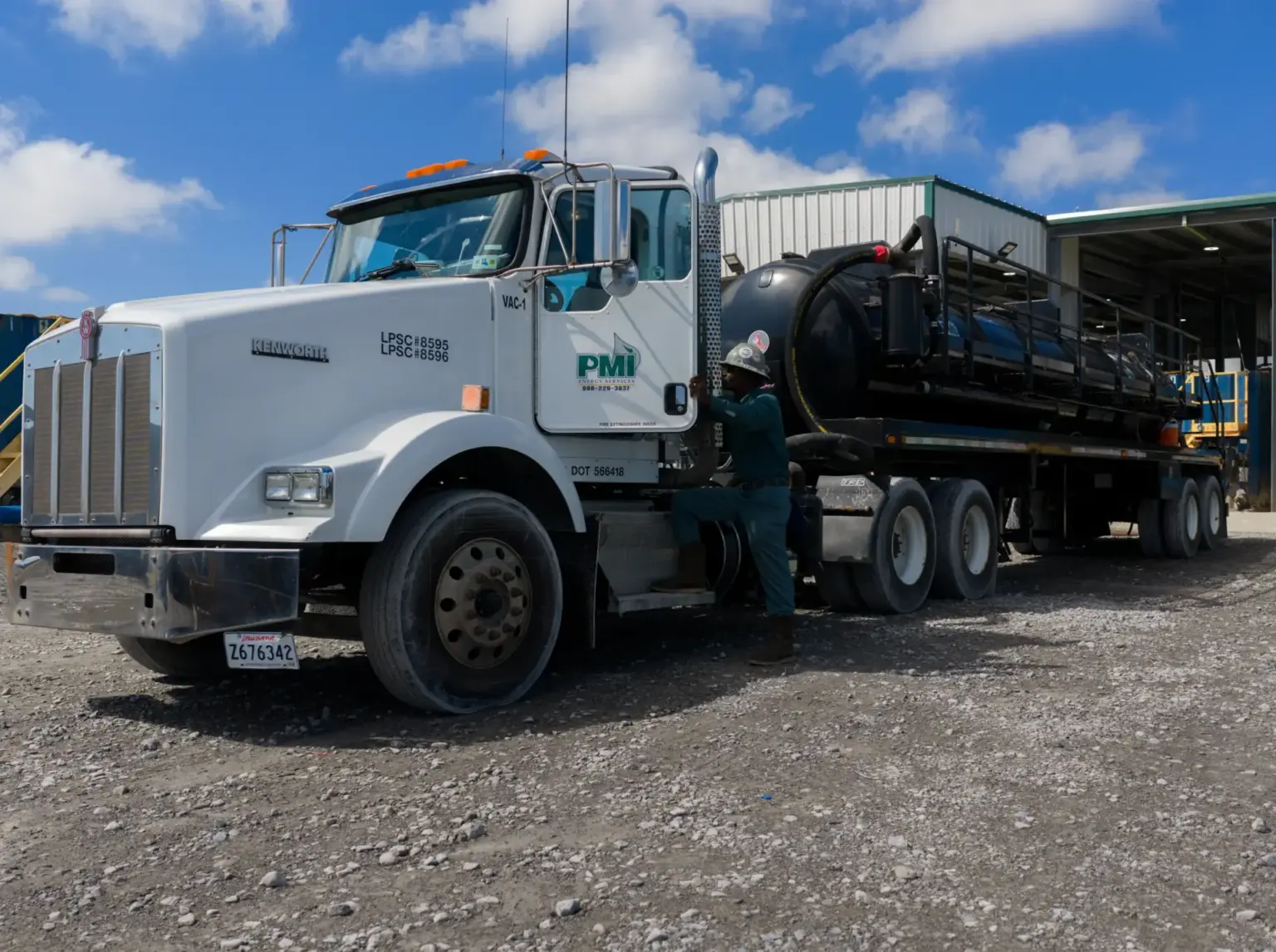
Spent chemistry and foulants are pumped into enclosed vacuum trucks or frac tanks and leave on manifests we handle.
Return to service
The system is rinsed, recharged with fresh glycol or amine and pressure-tested, the blinds come out and the unit goes back online.
Questions we get
Dehy System Flushing (Glycol & Amine) FAQs
Which systems do you flush?
Glycol dehydration units (TEG and EG), amine sweetening systems (MEA and MDEA) and heat exchangers. Exchangers can be flushed in place, and they are often brought to PMI's own shop for the work.
How do we know the unit needs a flush?
The usual signs are gas going off spec on dew point or sour gas content, foaming and fluid carryover, a reboiler burning more fuel gas to hold temperature, and differential pressure climbing across filters, carbon beds or tower trays. Any one of them is worth a call before it turns into an outage.
Why flush on a schedule instead of waiting for a problem?
A planned flush breaks down soft sludge with chemistry while the unit is still in good shape. Run a system until it plugs and the cleaning gets harder, the outage is unplanned, and parts inside the unit can end up needing repair or replacement.
Will the cleaning chemistry hurt our metallurgy or seals?
The chemistry is chosen for what is fouling your system and for the materials it has to run through. Tell us what the unit is built from and we will plan the flush around it.
Do you take care of the waste?
Yes. Spent chemistry and foulants go into enclosed vacuum trucks or frac tanks, and we handle the manifests for what we haul.
How do you know the system is clean?
Our technicians titrate the cleaning solution throughout the flush. When the chemistry stops picking up foulants and the readings hold steady, the cleaning is complete.
Tell us what the unit is doing.
Send the unit type, what you are seeing (dew point, foaming, fuel use, pressure drop) and when you can take it down. We will plan the flush around your schedule.