Wash Water Recycling & Reclamation (EC-AOP)
95 to 97 percent of your wash water reused or discharged on site instead of trucked to disposal.
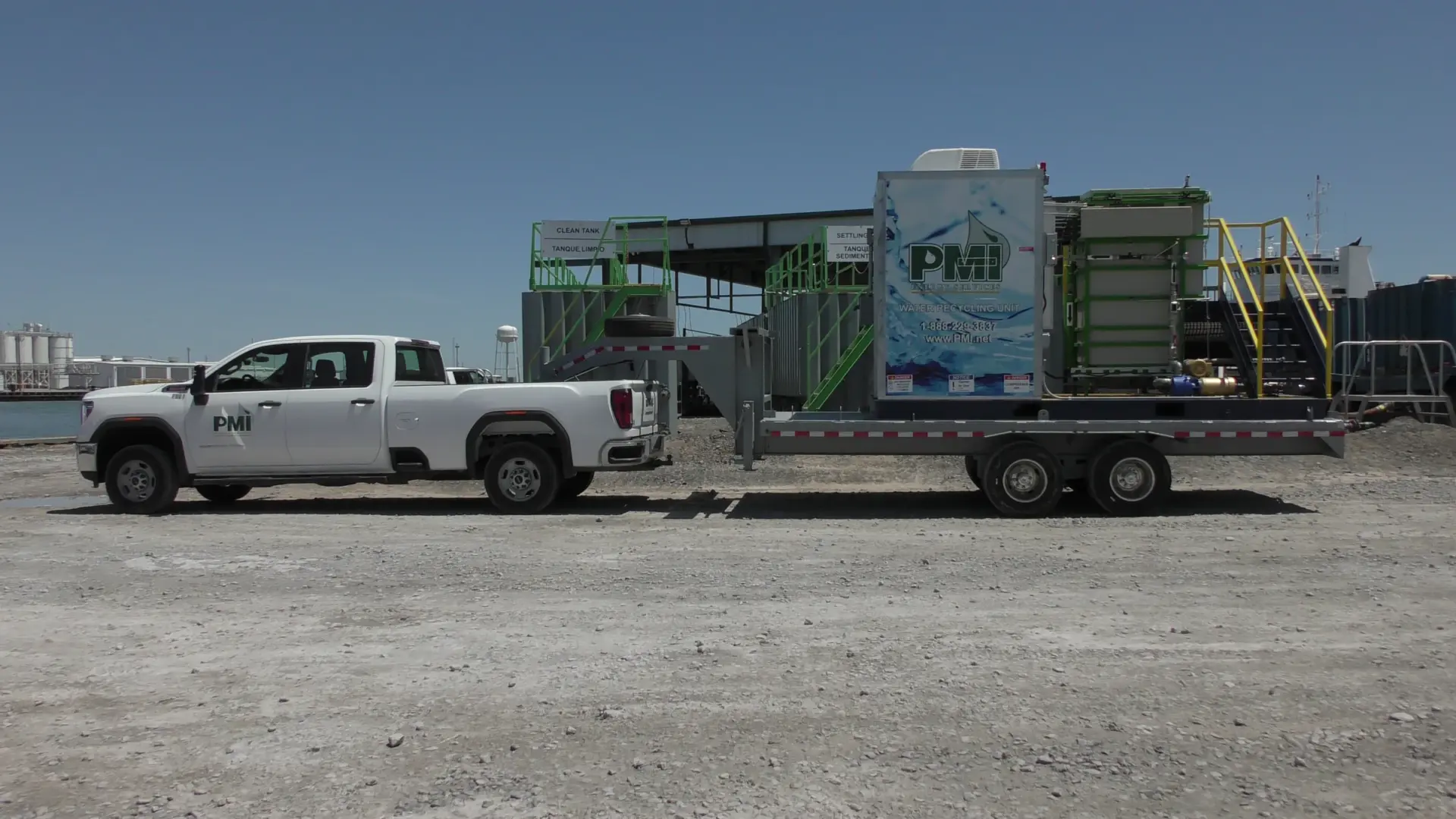
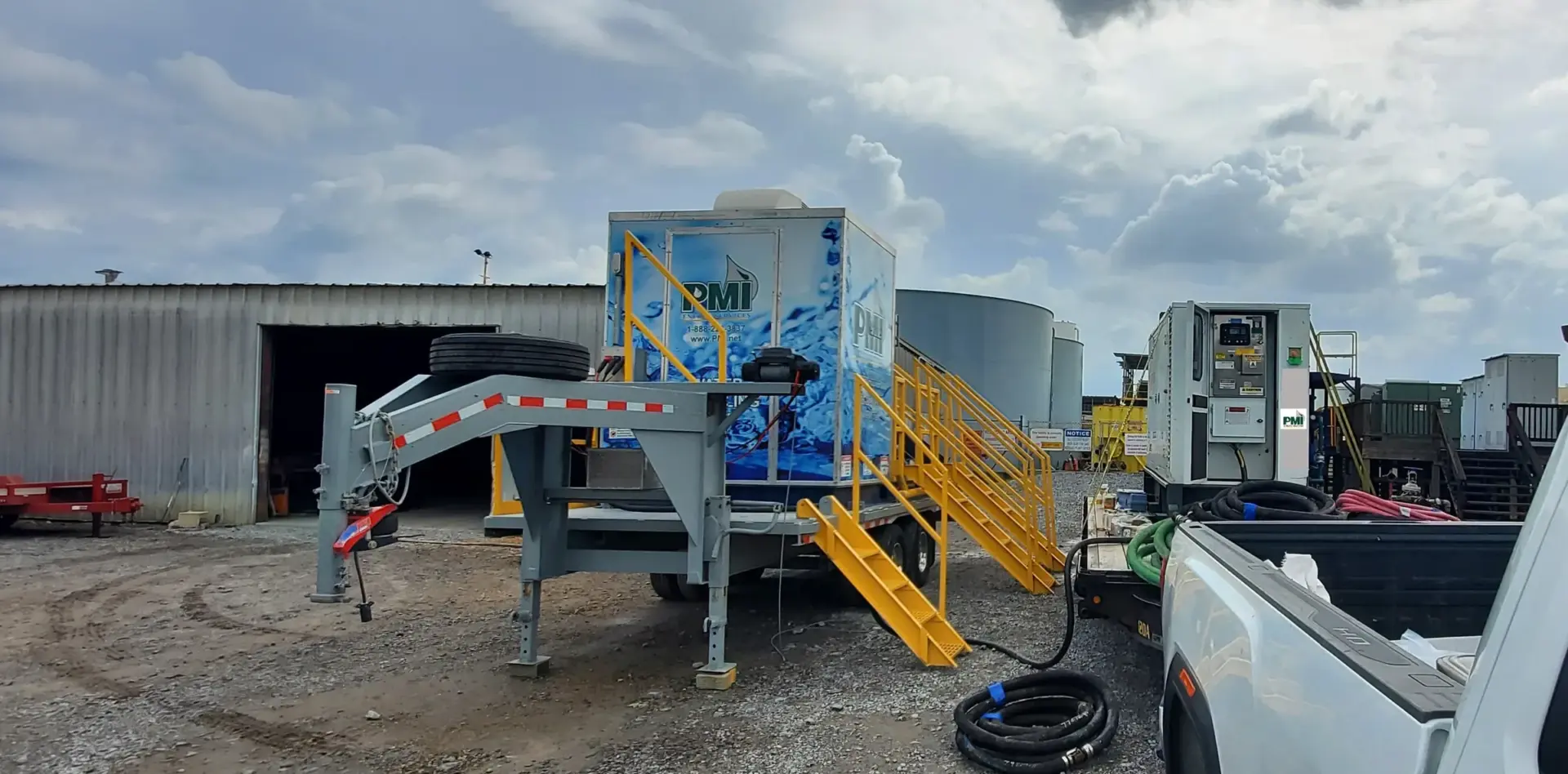
PMI runs two mobile EC-AOP units that treat wash water, flush water and wastewater at your site, with no chemicals and no polymers. Both units deploy anywhere in the continental US and install in 2 to 4 hours.
The record
- 95-97%of processed water reused or discharged
- $7MM+saved by clients at Port Fourchon
- 7+ yrsrecycling all OSV wash water at Fourchon
- 25 GPMper unit, scalable when you need more
- 2-4 hrtypical installation
- 97-99%hydrocarbon removal

The problems this ends
Disposal and trucking charges that can double the real cost of a tank or barge cleaning job.
A waste stream you stay accountable for long after the trucks leave the gate.
Truck traffic that adds highway risk and CO2 emissions to every job.
Cleaning operations that stop when your disposal facility goes down.
Water problems that don't fit the standard disposal route, from landfill leachate to H2S-laden tank water.
Scope of work
What you get
Electro coagulation pulls out suspended solids, metals, oils, and greases; advanced oxidation then breaks down hydrocarbons and organics using ozone generated on site from the air.It is one process run two ways: reclamation cleans water for reuse in your operation, processing treats it to meet discharge requirements.
Wash water recycling & reuse
Wash water treated and returned to service in your cleaning operation. At Port Fourchon we have recycled all of our OSV tank cleaning wash water this way for over 7 years.
Wastewater processing for discharge
The same EC-AOP process run to meet discharge requirements, removing 97 to 99 percent of hydrocarbons.
Mobile water reclamation
Truck-deployed units that install in 2 to 4 hours anywhere in the continental US, processing 25 gallons per minute and scalable beyond.
Leachate & specialty streams
Landfill leachate treatment that has brought down BOD, chromium, nickel, zinc, TSS, and sulfate for a national waste-services company.
H2S reduction
Contaminated tank water processed from 250 ppm H2S down to 40 ppm during an offshore tank cleaning. Treating it at the tank meant the water never shipped to shore in cuttings boxes, which saved that operator over $100,000 in box rentals, disposal, transportation and cleaning.
Continuity when disposal is down
Barge cleaning wash water processed on site for a midstream operator while its own disposal facility was offline. Cleaning never stopped.
In depth
What advanced oxidation takes out of water
Advanced oxidation processes (AOPs) are being put to work on a widening range of water problems. They break down or remove:
- Pathogens
- Industrial chemicals and other toxic compounds
- Pesticides
- Pharmaceuticals and personal care products (PCPs)
- Endocrine-disrupting compounds (EDCs)
- Persistent organic matter
- Metals and heavy metals
- Problems with the water’s odor, color and taste
Each of these is a recognized hazard to aquatic life and to human health, and water utilities worldwide now have to deal with them.
What the treatment does to the water
Bacteria, gases and NORM
- Kills bacteria and other pathogens by breaking down their cell walls
- Eliminates the hydrogen sulfide (H2S) already in the water
- Reduces NORM (naturally occurring radioactive material)
Oil, hydrocarbons and organics
- Lowers or eliminates BOD, COD and TOC
- Takes out hydrocarbons and VOCs
- Splits oil and water emulsions, then oxidizes and removes the oil constituents present in small percentages
- Removes fats, oils and greases
- Removes complex organic compounds
- Breaks down pharmaceuticals and pesticides
- Breaks down chlorocarbons, aromatics, phenolics, dyes and petroleum constituents
Solids, metals and nutrients
- Removes metals, including heavy metals
- Oxidizes heavy metals and ferrous iron (Fe2+)
- Removes suspended and colloidal solids
- Lowers phosphate and nitrogen levels
- Takes dissolved organics all the way: either fully separated out by precipitation, or fully mineralized
The goal
Cut the organic contaminants, the chemical contaminants and the overall toxicity of the water far enough that it can be returned to the environment, or reused as wash water on the cleaning job, which takes the cost of hauling it away and disposing of it off the table.
Why it suits a job site
- No chemicals and no treatment media go into the water.
- Chemical costs drop, since there are no chemicals to buy.
- No spill procedures or hazardous clean-up to plan for.
- Runs on its own, or alongside filtration equipment already on site to make it work better.
- Breaks down many hazardous compounds without creating new hazardous by-products that would need handling of their own.
- No chemicals to store, handle or spill.
- Small, modular and mobile.
Equipment on this service
The technology doing the work
Questions we get
Wash Water Recycling & Reclamation (EC-AOP) FAQs
What is EC-AOP?
Electro coagulation (EC) uses an electrical current to coagulate suspended solids, metals, and other impurities so they can be removed by flotation or settling. The advanced oxidation process (AOP) then breaks down hydrocarbons and other organic contaminants using ozone generated on site. Together they clean contaminated water to reuse or discharge quality.
Is wastewater processing a different service from water reclamation?
No. It is the same EC-AOP process run to different endpoints. Processing treats water so it can be discharged; reclamation cleans it so you can reuse it.
What kinds of water can the units treat?
Tank and vessel wash water, flush water, barge wash water, landfill leachate, and tank water carrying H2S. Both units are mobile, so the stream does not have to travel to us. Send an analysis of what you are holding and we will tell you whether EC-AOP is the right tool for it.
How much water can you process?
25 gallons per minute per unit, and the system is scalable when a project needs more.
Does EC-AOP remove hydrocarbons?
Yes, 97 to 99 percent, which meets most discharge requirements.
Will the treated water meet our discharge limits?
EC-AOP takes out 97 to 99 percent of hydrocarbons, which meets most discharge requirements. Send us the limits you are held to and an analysis of the stream, and we will confirm before anything mobilizes. We keep the documentation on what went in and what came out, so the record goes in your file and not just ours.
Does it remove salt?
No. EC does remove suspended solids, which lightens the load on downstream processes like reverse osmosis and makes them more efficient.
Are chemicals or polymers involved?
No. The coagulant is generated inside the unit by sacrificial anodes running on low-voltage electricity, and the only oxidant is ozone, made on site from the oxygen in the air. Nothing gets trucked in and mixed, so there is no chemical inventory sitting on your site.
What is left over after treatment?
Three to five percent of the volume, as inert solids. The other 95 to 97 percent is reused on site or discharged. Nothing chemical goes into the process, so there is no chemical sludge at the end of it.
How long does installation take?
Typically 2 to 4 hours from arrival to processing.
What does it cost?
Our objective on every project is to save you about half of what you would otherwise pay for trucking and disposal. On one chemical-plant tank cleaning, on-site reclamation saved over $32,000 in disposal costs alone. On an offshore tank clean, treating the water at the tank meant it never shipped to shore in cuttings boxes, which saved that operator over $100,000 in box rentals, disposal, transportation and cleaning.
Where can the units deploy?
Anywhere in the continental US where contaminated water is a problem: plants, terminals, docks, landfills, and offshore support operations.
See it working
Watch the process
Put a number on your disposal bill.
Tell us the water, the volume, and where it sits. We'll size the unit and show you the savings against trucking and disposal.